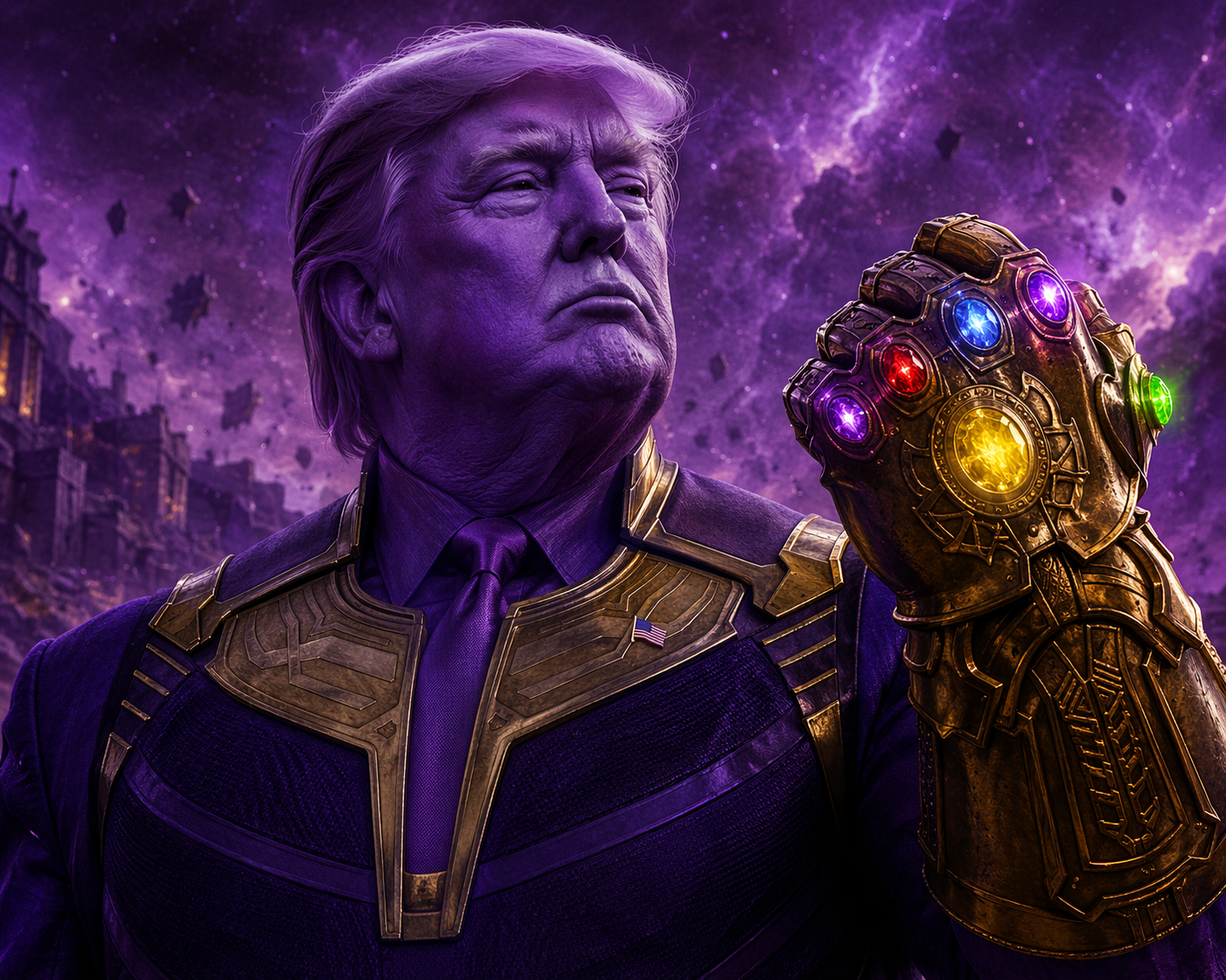
The Villain Didn't Want It Either
Trump threatened to destroy all of Iran's civilian infrastructure if Tehran does not reopen the Strait of Hormuz by tonight's deadline. His words — "a whole civilization will die tonight" — are the perfect villain's monologue from the very films Hollywood used to teach the world who the bad guys are. The script, it turns out, was never about nations. It was always about lines.

There's a scene Hollywood has repeated so many times it became a reflex. The planet is in danger. Aliens, asteroids, viruses, robots, space Nazis — it doesn't matter. Someone is going to die. A lot of people are going to die. And then, in a moment of dramatic silence, an American president steps up to a podium, looks into the camera, and says: we will not let this happen.
He saves civilization.
He always saves civilization.
In Independence Day, Will Smith and the American president destroy the alien fleet while the rest of the world watches. In Armageddon, Bruce Willis dies to save Earth because he was the only one who could — and naturally, he was American. In Interstellar, Matthew McConaughey travels beyond time and space to ensure humanity survives. In Avengers: Endgame, Iron Man snaps his fingers and erases Thanos — the villain who wanted to end half of all civilization.
The villain, notice, is always the one who wants to end civilization.
That is the unwritten rule of the script. The villain delivers speeches about inevitable destruction. The American hero arrives at the last second to stop it.
Until Tuesday morning, April 7th, 2026, when Donald Trump posted on Truth Social:
"A whole civilization will die tonight, never to be brought back again. I don't want that to happen, but it probably will."
Read it again.
That is not the hero's line. That is the villain's monologue.
For those who just arrived: the United States and Israel have been at war with Iran since late February. The Strait of Hormuz — the narrow passage through which a fifth of the world's oil travels in peacetime — has been closed by Iran. Trump set a deadline: reopen the Strait or face devastating strikes against all of Iran's civilian infrastructure. Power plants. Bridges. Water desalination facilities.
Today is the deadline.
This morning, airstrikes already hit two bridges and a train station inside Iran. Kharg Island, Iran's primary oil export terminal, was bombed. Iranians are forming human chains around power plants to serve as living shields. Iran's president says 14 million people have volunteered to fight.
And Trump writes that a whole civilization is going to die tonight.
International law experts are calling it a threat of war crimes. The United Nations Secretary-General warned that attacking civilian infrastructure is prohibited under the rules of war. France called for restraint. Human rights experts noted that threatening to collectively punish a civilian population is itself potentially a war crime. Trump said he is "not at all" concerned about committing war crimes.
The head of the International Energy Agency declared this the largest energy shock in history — more serious than 1973, 1979, and 2002 combined.
The Strait of Hormuz, closed. Kharg Island, burning. Oil prices, surging.
And a president posting on social media about the death of a civilization.
Thanos wanted to eliminate half of all civilization to, in his words, save the universe. He also, crucially, did not want to do it. He considered it inevitable. He was the greatest villain in the Marvel universe — despised by billions — for exactly that reason.
Trump wrote: I don't want that to happen, but it probably will.
The difference between Thanos and Trump, as of this afternoon, is that Thanos was fictional.
Hollywood spent decades exporting to the world the image of a nation that arrives at the last second to save everything. It saved Earth from aliens. It saved humanity from asteroids. It saved democracy from fascism. It saved the universe from a purple titan with a magic glove.
Today, the president of that same nation posts on a social network that a whole civilization is going to die tonight.
The script flipped. Nobody warned the audience.
There is still the possibility of a last-minute deal. Diplomatic sources speak of quiet progress behind the scenes. Vice President Vance, appearing in Budapest alongside Viktor Orbán — because that is the company this administration keeps — said the war will end "very shortly." Trump himself left a door open: "maybe something revolutionarily wonderful can happen."
It is the final-act scene. The hero can still appear.
The problem is that this time, the hero and the villain are posting from the same account.
M. Casamata writes from where the view is best: from the inside. A chronicler and observer of wars he never fought and politicians he never voted for. He believes the world is heading somewhere — he's just not sure where. Writing at The Bunker 26 since 2026.
Comments
Offensive or disrespectful comments may be removed by the administration.