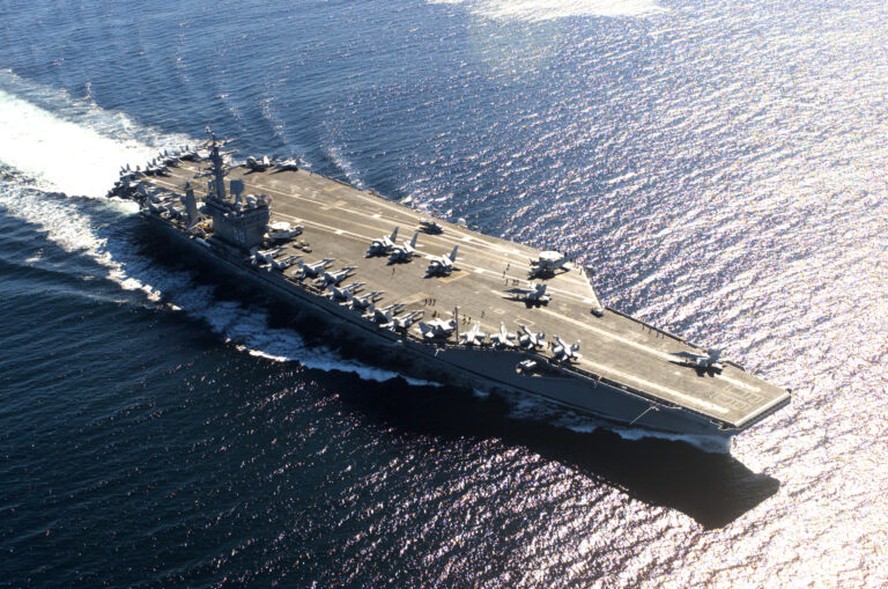
The Aircraft Carrier Didn't Come for the View
The USS Nimitz anchors in Rio the same week USA Rare Earths announces a $2.8 billion acquisition of a Brazilian mining company. South America holds the world's second-largest rare earth reserves, and Washington is not here for the scenery.

The oldest nuclear aircraft carrier still in operation anchored in Rio de Janeiro this week. The internet reacted as expected. Photos. Comparisons to football stadiums. Defense enthusiasts delighted. And then nothing. Story over. Move along.
But why now?
That is the question almost nobody asked.
The USS Nimitz is 51 years old. It was commissioned before the fall of Saigon was forgotten, before the Berlin Wall came down, before the internet existed. It will be decommissioned in 2027. Its final operational mission is a circumnavigation of South America — a mandatory route around Cape Horn, since the ship is too large for the Panama Canal. The U.S. Navy decided to turn this obligatory farewell into something else entirely: a demonstration.
Ten partner nations. Joint exercises. Invited authorities aboard. Press releases about "building maritime trust and interoperability."
A ship headed for the scrapyard in 2027 is being used to send a message in 2026.
What message?
In January of this year, the United States bombed Venezuela and captured President Nicolás Maduro. This was not improvisation. It was the practical application of a written, published, signed document: the 2025 National Security Strategy, which explicitly invokes the Monroe Doctrine and declares the Western Hemisphere an American sphere of influence — no China, no Russia, no outside interference permitted. The informal name that stuck was the "Donroe Doctrine." A joke that contains a threat.
South America is not merely a continent of carnivals and football. It is the lithium triangle — Argentina, Bolivia, Chile. It holds the world's largest freshwater reserves. It has oil in Venezuela. And it holds the second-largest rare earth reserves on the planet.
Second largest. Behind only China.
Rare earths are the 17 chemical elements inside every electric vehicle, every wind turbine, every fifth-generation fighter jet, every advanced defense chip. Deng Xiaoping once said that the Middle East has oil, China has rare earths. That was not a metaphor. It was a long-term strategy. And it worked: Beijing controls between 60 and 90 percent of the global supply chain — from mining to refining to the finished product.
When China threatened to restrict rare earth exports in 2025, Washington panicked. Since then, it has been accelerating its search for alternatives with unusual urgency.
Now pay attention to the calendar.
In the same week the USS Nimitz drops anchor off Rio de Janeiro, American company USA Rare Earths announces the acquisition of Serra Verde — a Brazilian rare earth mining company in the state of Goiás — for $2.8 billion. The same week. The warship and the contract. The muscle and the wallet. The visit and the check.
This is not coincidence. It is a sequence.
In February, Washington had already extended a $565 million loan to Serra Verde — the same company now being purchased for $2.8 billion. First they finance. Then they buy. In March, U.S. officials held a forum in São Paulo and declared interest in at least 50 Brazilian critical mineral projects — rare earths, lithium, graphite, niobium, cobalt. The pattern is consistent, the pace is accelerating.
The geopolitical logic is not complicated. Brazil holds the world's second-largest rare earth reserves. It produces less than one percent of global supply. It has the ore. It does not have the refinery. And that gap — between what is in the ground and what can be done with it — is exactly where the great power competition is playing out.
This is the new resource war. Not tanks rolling across borders. Loans, acquisitions, naval visits, and the quiet arithmetic of who processes what for whom.
Brazil is not cooperating on Washington's terms, at least not yet. The country is playing a multipolar game — negotiating with Washington while maintaining economic ties with Beijing, which has invested approximately $67 billion in Latin America and has designated the region central to its 15th Five-Year Plan. At a summit in Bogotá, Brazil's president said the country will not be "a mere exporter of raw minerals." Legislators in Brasília are pushing for a state-owned company to develop the reserves domestically rather than surrender them raw to foreign buyers.
Washington's patience has structural limits. The Peterson Institute published a blunt analysis: a U.S.-Brazil critical minerals deal "is certain — with the current government or the next one." The subtext is not subtle. If the current administration does not deliver, the next one will. Milei delivered in Argentina. The U.S. is betting on electoral arithmetic.
Brazil holds general elections in October 2026.
The USS Nimitz is not a threat. Nobody is bombing Rio. That is not how this particular game is played.
The game is presence. Signaling. The diplomatic equivalent of a handshake that lasts one second longer than comfortable. You feel it. You understand. Nothing needs to be said aloud.
The United States maintains roughly 76 military bases across Latin America. The Monroe Doctrine has been rebranded, dusted off, and applied — not metaphorically, but with actual munitions — for the first time since Panama in 1989. The largest U.S. rare earth company just acquired a Brazilian mine for $2.8 billion. And the oldest active aircraft carrier in the world is on a "partnership mission" with ten nations along the South American coastline.
The tourists in Rio are still photographing the ship.
It does look impressive against the mountains.
M. Casamata writes from where the view is best: from the inside. A chronicler and observer of wars he never fought and politicians he never voted for. He believes the world is heading somewhere — he's just not sure where. Writing at The Bunker 26 since 2026.
Comments
Offensive or disrespectful comments may be removed by the administration.