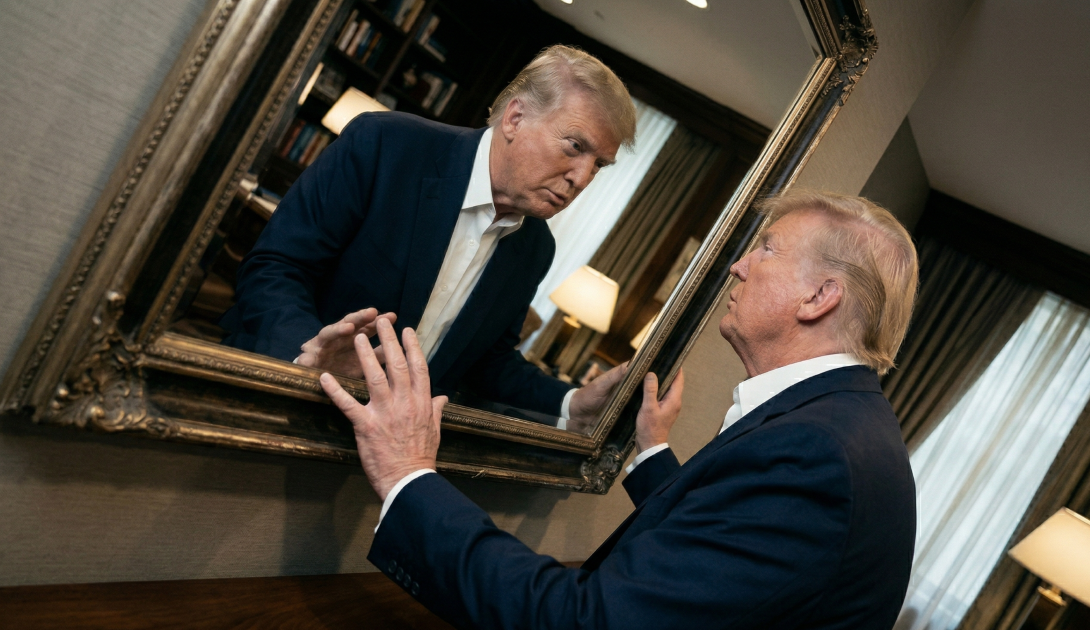
The Man Who Negotiated with His Reflection
Trump declared "very productive" negotiations with Iran. Iran responded that no negotiations existed — the Iranian military spokesman summarized with surgical precision: "You are negotiating with yourselves." A chronicle about what happens when diplomacy requires two parties, but only one believes it exists.

"You are negotiating with yourselves."
That line didn't come from a TV pundit. It came from Iranian military spokesman Ebrahim Zolfaqari, in direct response to Donald Trump's claim that "very good and productive conversations" were underway with Tehran. Issued the same day. Same cameras rolling. Two countries, two communiqués, two incompatible realities running in parallel.
Trump said there were negotiations. Iran said there were no negotiations. This isn't a dispute about details — about who concedes what, about timelines and dismantled centrifuges and inspection windows. It's a dispute about whether the phenomenon exists at all. About whether the word "negotiation" describes anything real, or whether it's just Trump describing a Trump declaration.
Lewis Carroll wrote about this. He called it something else.
There is a precise mechanics to what is happening. Trump needs an exit. He called the strikes a success. Announced a five-day pause. Said the pause was the result of "conversations" — which implies there's an interlocutor, a structure, the beginning of an agreement. Iran has no interest in granting that framing. A negotiation you don't acknowledge as a negotiation is still one in which you're conceding. So Iran denies it. Not the content of any conversations — the existence of them.
The paradox isn't tactical. It's ontological.
In 1972, Henry Kissinger declared that "peace is at hand" in Vietnam. The war ran three more years and produced a treaty neither side honored. The statement was technically accurate — peace was at hand. The problem was nobody had told both sides simultaneously that it was time to reach for it. But in Vietnam, there was at least a table in Paris, even if delegations refused to acknowledge each other for months. What Trump described last week was a table with no chairs — and the chair across from him was occupied by someone who didn't know they were sitting down.
On Thursday, the American government delivered to Iran, via intermediaries in Pakistan and Egypt, a 15-point peace proposal. Iran responded with a 5-point counterproposal that includes war reparations, permanent non-aggression guarantees, and sovereign control over the Strait of Hormuz. The two documents are incompatible at the foundation. Not a question of adjusting percentages or enrichment schedules. A question of one party starting from the premise that it won, and the other starting from the premise that it was bombed.
It was.
The intermediaries know this. Pakistan and Egypt are in the middle, reporting back to Washington that the very deployment of additional American forces to the Gulf is increasing Iranian suspicion that the peace plan is a tactical maneuver. Washington listens, keeps deploying, and keeps calling it a negotiation. An intermediary who tells the truth and isn't heard isn't a mediator anymore — they're a witness.
Natanz still stands, but the door is blocked. American bunker-buster bombs caused enough damage to make the facility inaccessible without destroying it. Iran retains the technical and scientific expertise to rebuild everything. The expiration date on the "victory" is printed on the bottom of the package.
Meanwhile, oil prices fell on Monday when Trump announced the pause. They fell because markets believed Trump's declarations about negotiations that Iran says don't exist. At some point, someone will have to figure out who's right. That moment won't be a gentle correction.
The economies most exposed are the ones with the least leverage in this room. Asian nations import over 80% of their oil through the Strait of Hormuz. Japan has no domestic energy. South Korea's industrial base runs on Gulf crude. India's growth narrative depends on affordable oil. A prolonged conflict — or an agreement that grants Iran structural control over the Strait — rewrites the energy math for half the planet.
Europe already restructured its energy supply once, after Ukraine. A second shock, this one from the Gulf, would arrive before that restructuring is complete.
There is something distinctly American about Trump's position here. The belief that declaring a negotiation creates the negotiation. That announcing the pause is half the work of making the pause hold. Nixon went to China without warning anyone and it worked — because Mao knew he was receiving Nixon. Reagan secretly negotiated with Iran to release hostages and it worked — because Iran knew what it was selling. Surprise diplomacy, when it functions, functions precisely because both sides know what's happening and choose, for their own domestic reasons, to call it something else publicly.
The problem this week is different. Iran is calling it by its real name: you are negotiating with yourselves. That's not a diplomatic position. It's a user manual.
Trump will announce a deal. Iran will say it isn't a deal. Markets will swing. Analysts will calculate who conceded more. And the American 15 points and the Iranian 5 points will remain as two documents that existed simultaneously, in the same conflict, without ever touching.
Carroll called it theater. Kissinger called it realism.
Trump will call it a win.
M. Casamata writes from where the view is best: from the inside. A chronicler and observer of wars he never fought and politicians he never voted for. He believes the world is heading somewhere — he's just not sure where. Writing at The Bunker 26 since 2026.
Comments
Offensive or disrespectful comments may be removed by the administration.