The Map Nobody Read
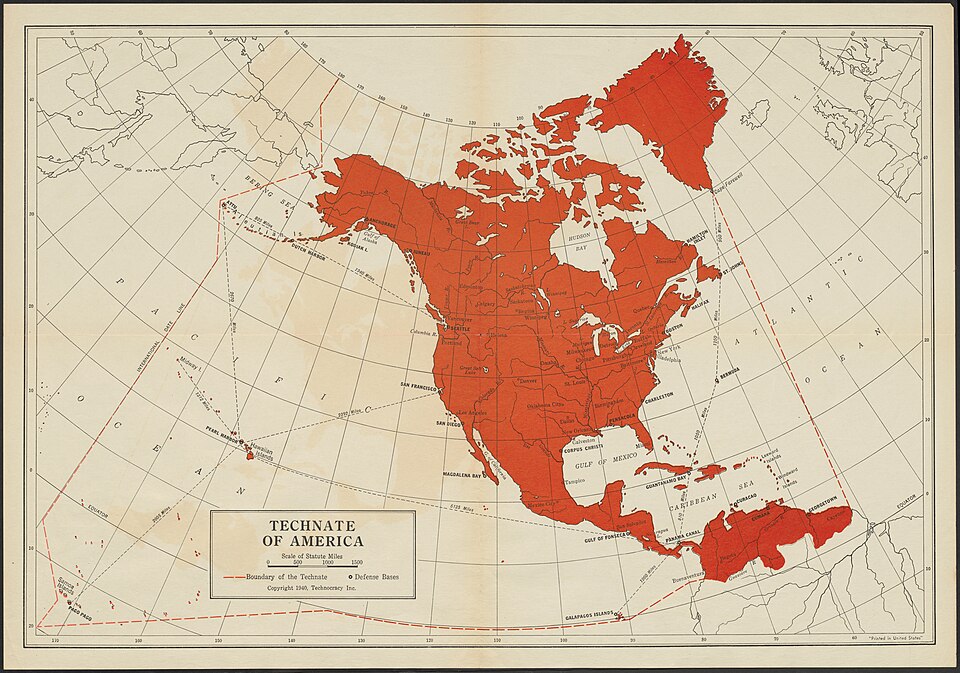
In 1940, a map proposed merging the Americas, Greenland and the Caribbean into a single domain governed by technocrats. Elon Musk's grandfather led the movement in Canada. Eighty-six years later, the pieces of that map are moving — Venezuela, Greenland, Iran — and nobody seems to have read the manual.

There is a map. It was drawn in 1940, in a New York office, by an engineer who stood six foot five, chain-smoked his way through every meeting, and was thoroughly convinced that democracy was a bad joke. His name was Howard Scott. The movement he led was called Technocracy Incorporated. And the map he published that July — while Hitler devoured Europe and Americans pretended it wasn't their problem — showed something that, at the time, looked like the blueprint of a madman.
North America was not a continent divided into countries. It was one thing. A machine. A single industrial domain stretching from Greenland to Panama, swallowing the entire Caribbean, biting into the northern edge of South America — Venezuela, Colombia, the Guianas — and scattering military bases across strategic islands in both oceans. Pearl Harbor, the Galápagos, Bermuda, Cape Farewell.
They called this creature the Technate of America.
Scott's logic was brutal in its simplicity: politicians are fools, elections are theatre, and money is an illusion. The world should be governed by engineers and scientists — an unelected technical elite making decisions based on energy and resources. No currency. No ballots. No borders getting in the way. The continent would be a factory. And factories don't need parliaments.
Sounds like science fiction, doesn't it? Well, the members of Technocracy Inc. wore identical grey uniforms and were identified by numbers instead of names. Member 10450-1, for instance, was a Canadian chiropractor named Joshua Haldeman. Leader of the movement in Canada. Arrested by the Royal Canadian Mounted Police in 1940 for belonging to an organization deemed subversive. Inside his home, officers found documents sympathetic to Nazi Germany. After the war, Haldeman founded another political party, promoted The Protocols of the Elders of Zion — that immortal antisemitic forgery — and when Canada ran out of patience for him, he packed his bags and left for South Africa. In 1950. Just in time to embrace apartheid with open arms.
Haldeman had a granddaughter named Maye. Maye had a son. The son's name is Elon.
There. Now you know where this story comes from. Now look at the Technate map again. Look carefully. Greenland. Venezuela. The Caribbean. Panama. Bases at chokepoints. Continental control of natural resources. A technical elite in command, free from the inconvenience of politics.
Now open the newspaper from January 2026.
On January 3, before dawn, the United States bombed Caracas. Operation Absolute Resolve. They captured Nicolás Maduro in his bed — literally — and put him on a plane to New York, where he'd face charges of narco-terrorism. That same afternoon, Trump held a press conference at Mar-a-Lago and said, with that casualness only he can muster: "We're going to run the country." It wasn't a suggestion. It was a memo. American oil companies, he explained, would rebuild Venezuela's petroleum infrastructure. Revenues would be deposited in U.S. Treasury accounts. And the United States would maintain "a presence in Venezuela as it pertains to oil."
Three days later, on January 6, the formal deal came: between 30 and 50 million barrels, sold at market price. The Department of Energy pegged the value at up to $2.8 billion. On January 9, an executive order declared a national emergency to shield that money from any legal process. On January 14, the first sale closed: $500 million. In under two weeks, Venezuelan oil was already being traded as an American asset.
Notice the rhythm: Day 3, bombs. Day 6, contract. Day 9, legal armor. Day 14, cash in the register. This isn't improvisation. This is an assembly line.
But the machine didn't stop in Caracas.
Four days after Maduro's capture, Stephen Miller — White House Deputy Chief of Staff, the kind of man who seems to have been born inside a classified memorandum — declared that the United States had the right to take Greenland. His wife, Katie Miller, posted a map of the island draped in the American flag with a single word: "SOON."
Trump threatened 25% tariffs on eight European countries — including Denmark, the nominal owner of Greenland — if they didn't hand it over. He ordered the Joint Special Operations Command to plan a "possible invasion." When journalists asked about international law, he answered with a sentence that deserves to be framed: "I don't need international law. My own morality. My own mind. It's the only thing that can stop me."
If Howard Scott were alive, he'd have given a standing ovation.
Because that is precisely what the Technate proposed. Resource control without the inconvenience of laws, borders, or diplomacy. The 1940 map drew Greenland as part of the continental domain — and it did so for a precise reason: rare earth minerals, uranium, Arctic shipping routes. Everything that, in 1940, was strategic for a continental autarky. Everything that, in 2026, is strategic for whoever wants to dominate the century's energy chessboard.
Now, I'm not saying Trump read Howard Scott's map. Trump has probably never heard of Howard Scott. But someone very close to Trump has. And not only heard — grew up with this story in his blood.
Elon Musk, the richest man on the planet, the man running DOGE — that department whose stated mission is to replace bureaucrats with algorithms — grew up listening to his grandfather Joshua's adventures. Biographer Ashlee Vance wrote that young Elon would sit through family gatherings, mesmerized, watching slide shows of his grandfather's expeditions across Africa. "My grandmother told these tales of how they almost died several times along their journeys," Musk said in an interview. He heard these stories the way children hear founding myths. And he absorbed them.
Musk once said, at the World Government Summit in Dubai, that he wanted to build a "Martian technocracy." His company is named Tesla — the engineer the technocrats worshipped as a prophet. His government department exists to slash agencies, gut regulations, let the machine run without interference from elected politicians. In a recent statement, Musk said: "We really have here rule of the bureaucracy as opposed to rule of the people — democracy." Howard Scott said exactly the same thing. Different words, different century, grey uniform instead of black t-shirt. But the same thing.
And this is where the threads start crossing in ways that make you uncomfortable.
The technocrats wanted an economic system based not on money but on energy. Whoever controlled the energy controlled everything. Now look at what Trump is doing: this isn't just a war here, a threat there. It's an energy project. Venezuela gave him oil — massive amounts of it, some of the largest reserves on the planet. Greenland would give him strategic minerals and Arctic routes that China and Russia covet. And Iran?
On February 28, the United States and Israel launched Operation Epic Fury against Iran. Ayatollah Khamenei was killed. Iran's military leadership, decimated. Iran retaliated with missiles against Israel and American bases across six countries. And the Strait of Hormuz — that 21-mile corridor through which one-fifth of all the world's oil flows — closed.
Crude prices spiked. Markets panicked. Insurers pulled war-risk coverage. Ships bound for the Persian Gulf had to reroute around the whole of Africa — weeks of extra sailing, costs tripled overnight.
But notice the detail — and this is the detail that separates reading the news from understanding the game: Trump already had Venezuelan oil in his pocket when Hormuz closed. General Dan Caine said at the January 3 press conference that the Venezuela operation had been "planned for months." An Israeli official said the Iran strikes were "planned for thousands of hours."
Months of planning to secure the alternative source. Thousands of hours to cut off the main one.
People who do this don't improvise. People who do this read maps.
And if you still think I'm pulling threads that don't exist, stay with me for one more moment. Because there is a final thread, and it's the most uncomfortable of all.
Remember the Epstein Files? Congress passed the Epstein Files Transparency Act in late 2025, ordering the Justice Department to release every document related to Jeffrey Epstein and his network. The deadline was December. The DOJ missed it. In January, while the world was hypnotized by the explosions in Caracas and the threats against Greenland, less than 1% of the documents had been published. Nobody complained. There were more urgent things in the news — or at least they seemed more urgent.
On January 30, the DOJ finally released 3.5 million pages. Trump was mentioned over a thousand times. Victims' names, which should have been protected, were published unredacted. Names of powerful men, which should have been revealed, were carefully blacked out. A perfect inversion.
But the real bomb came on February 24, when NPR published a meticulous investigation showing that the Justice Department — the very one that serves the president — had removed or withheld dozens of pages from the files. Specifically, the pages containing sexual abuse allegations against Trump involving a minor. The FBI had interviewed the accuser four times. Records indicate that at least 50 pages of interviews and notes simply vanished. The tracking numbers stamped on the documents — those sequential seals that don't lie — jump from one file to the next with inexplicable gaps.
The House Oversight Committee, led by Republicans and Democrats together, opened an investigation.
And four days later — four days — the missiles fell on Iran.
Hormuz closed. Gold surged. Oil went haywire. And the world forgot, instantly, that the President of the United States has pages ripped from a criminal file that he himself signed the law to release.
I'm not saying Trump attacked Iran to bury the Epstein Files. That would be too crude, too simplistic. What I'm saying is something else: in a well-built machine, you don't need every part to know what the other parts are doing. You just need them all to move at the right time. Venezuela in January. Greenland in January. Epstein in January. Iran in February. Public attention is a finite resource — perhaps the most finite of all — and when you overload it, it collapses. Headlines cannibalize each other. Nobody processes anything. And in the silence of the chaos, the pieces on the board are quietly moved into position.
Howard Scott published the Technate map in July 1940. Europe was burning. America pretended it wasn't their concern. Scott wanted to use the distraction of a world at war to consolidate the continent under technical control.
Eighty-six years later, the continent is being consolidated. Not with grey uniforms. With tweets, drones, executive orders, and the richest man in the world operating a bureaucratic guillotine inside the White House.
The 1940 map showed America as a resource machine. Venezuela was one bolt. Greenland, another. The Caribbean, the transmission belt. Military bases at the pressure points. Total energy control. A technical elite in command.
Now look at 2026 and tell me what changed.
The name changed. It used to be called the Technate of America. Now it's called America First.
And that's the rabbit hole. It's not that nobody's looking. Everyone is looking. At the wrong thing.
M. Casamata writes from where the view is best: from the inside. A chronicler and observer of wars he never fought and politicians he never voted for. He believes the world is heading somewhere — he's just not sure where. Writing at The Bunker 26 since 2026.
Comments
Offensive or disrespectful comments may be removed by the administration.