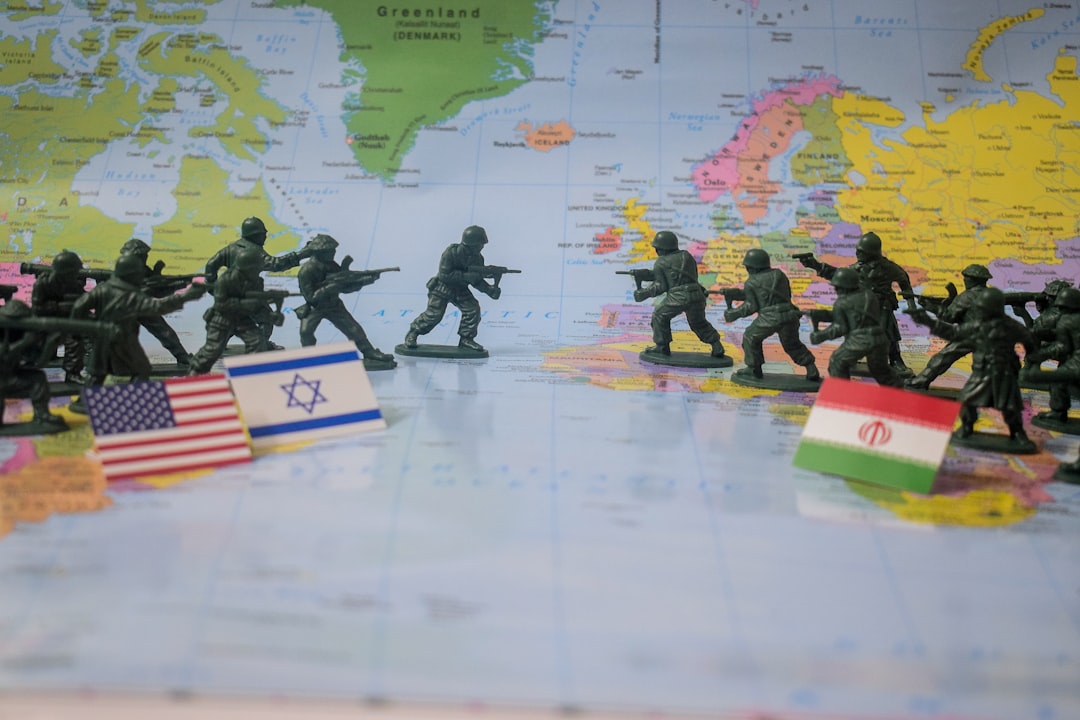
Who's Protecting Whom
Ukraine — the country Trump spent months trying to negotiate out of the picture — has become the world's foremost expert in drone countermeasures and is now protecting American soldiers in the Gulf from Iranian drones supplied by Russia. A geopolitical reversal nobody predicted, with consequences for NATO, European autonomy, and the architecture of Western security.

At some point in 2026, the roles reversed. Nobody announced it.
Ukraine — the country Donald Trump spent months trying to negotiate out of the picture, the country he used as a bargaining chip with Putin, the country he called "not so innocent either" — that country is now deploying counter-drone teams to protect American soldiers in the Persian Gulf.
Let me say that again. Ukraine is protecting the United States.
This isn't a metaphor. Eleven formal requests are sitting on Zelensky's desk — from countries neighboring Iran, from European allies, from the Americans themselves. Everyone wants Ukraine's expertise in electronic warfare. Two years of surviving Russia turned Kyiv into the world's most advanced laboratory for drone countermeasures. And now, as Iranian drones swarm American bases and Saudi oil facilities, the country arriving with the operating manuals is exactly the one Trump almost discarded.
The irony isn't accidental. It's structural.
The problem began in 2025. Trump spent his second term's first year signaling that the United States was tired of funding someone else's war. He pushed for negotiations. He gestured toward Putin. He questioned NATO's value. He slowed arms deliveries. The message was clear: Ukraine needed to be realistic, sit at the table, and accept that wars cost too much to last forever.
Then Iran went to war.
The Strait of Hormuz closed. Dubai burned. Oil went to $120. And suddenly the Americans needed someone who knew how to bring down an Iranian drone without turning the Gulf into a crater — someone with real, field-tested experience, not simulated in Fort Bragg. Nobody fit the profile better than the army that spent two years as a target for almost everything Russia had in its arsenal, and learned to answer back.
This reversal has consequences that extend well beyond the battlefield.
The first is military architecture. Ukraine is no longer a recipient of Western security — it is a producer of it. The knowledge gap has closed and then inverted. Kyiv's drone warfare doctrine, its electronic countermeasures, its battlefield AI — these are now assets that allies are lining up to access. The country that was supposed to be a burden has become a resource.
The second consequence is political. On March 17, Zelensky flew to London. King Charles III received him at Buckingham Palace. Prime Minister Keir Starmer signed a £500 million partnership for an "AI excellence center" for military use in Kyiv. This is not diplomatic courtesy. It is the outline of a new European security architecture — one being drawn without Washington in the room, or more precisely, with Washington as an unreliable variable.
The historical parallel is 1940. Britain stood alone. Churchill asked the Americans for weapons. Roosevelt wanted to help, but Congress resisted. The solution was Lend-Lease: the US lent the material, Britain promised to repay after the war. What changed in 2026 is that it is Ukraine doing the lending — not in weapons, but in knowledge. In minds that know how to shoot down what the Iranians are launching.
There is a name for this in geopolitics: a shift in relative power positions.
There is a simpler name too: surprise.
Trump bet that a small, exhausted, pressured country would yield. That Ukraine would do what weaker countries do — accept the terms of the stronger ones. Instead, Ukraine became indispensable. Not through the logic of weakness. Through the logic of scarcity and need.
Somewhere in the background, the Russia-Iran axis is watching this with complicated feelings. Moscow supplied the drone technology that Tehran is now launching at American targets. Kyiv developed the countermeasures to defeat exactly that technology — and is now deploying those countermeasures to protect the very Americans that Russia hoped to bleed. The circle closes in a way that no strategist in Moscow or Washington would have drawn on a whiteboard.
There is a scene that captures all of this better than any analysis.
At some point this February, an American soldier — serving at some base in the Gulf — was protected from an Iranian drone by a countermeasure system operated by Ukrainians. The same type of drone Russia sent against Kyiv. The same type of system Ukraine developed to survive.
Russia supplied the drones to Iran. Ukraine shot them down to save Americans.
Who's protecting whom, exactly?
M. Casamata writes from where the view is best: from the inside. A chronicler and observer of wars he never fought and politicians he never voted for. He believes the world is heading somewhere — he's just not sure where. Writing at The Bunker 26 since 2026.
Comments
Offensive or disrespectful comments may be removed by the administration.